
CoLiBRIE: Peak-Load-Free Housing for Future-Proof Residential Development
Through the OPZuid project CoLiBRIE, ClimAd Technology and its partners are working on a new generation of grid-friendly homes. CoLiBRIE stands for Comfortable Lightweight Building Reduces Impact on the Energy Grid and addresses an urgent societal challenge: combining accelerated housing development with a stable and future-proof energy system.
The Netherlands is currently facing both a major housing shortage and increasing grid congestion. New construction projects are increasingly delayed due to limited electricity grid capacity. CoLiBRIE therefore focuses on developing homes that place virtually no additional burden on the energy grid, without compromising on comfort or sustainability.
The homes are constructed using lightweight biobased materials and equipped with innovative energy technologies. These include ClimAd Technology’s smart solar control window film, solar-thermal energy systems, thermal energy storage and intelligent battery management systems. By locally balancing and intelligently managing energy peaks and fluctuations, the homes can operate with a minimal grid connection of only 4 kW.
In addition, the project is developing an advanced design model that enables the performance of these homes to be easily simulated and validated. The innovations will be tested and demonstrated in real-life residential units, making CoLiBRIE an important step towards scalable, affordable and energy-efficient housing solutions.
Within CoLiBRIE, ClimAd Technology contributes its expertise in smart solar control window films. This technology actively reduces solar heat gain inside buildings, lowering cooling demand and further reducing peak loads on the electricity grid.
Who makes it possible?
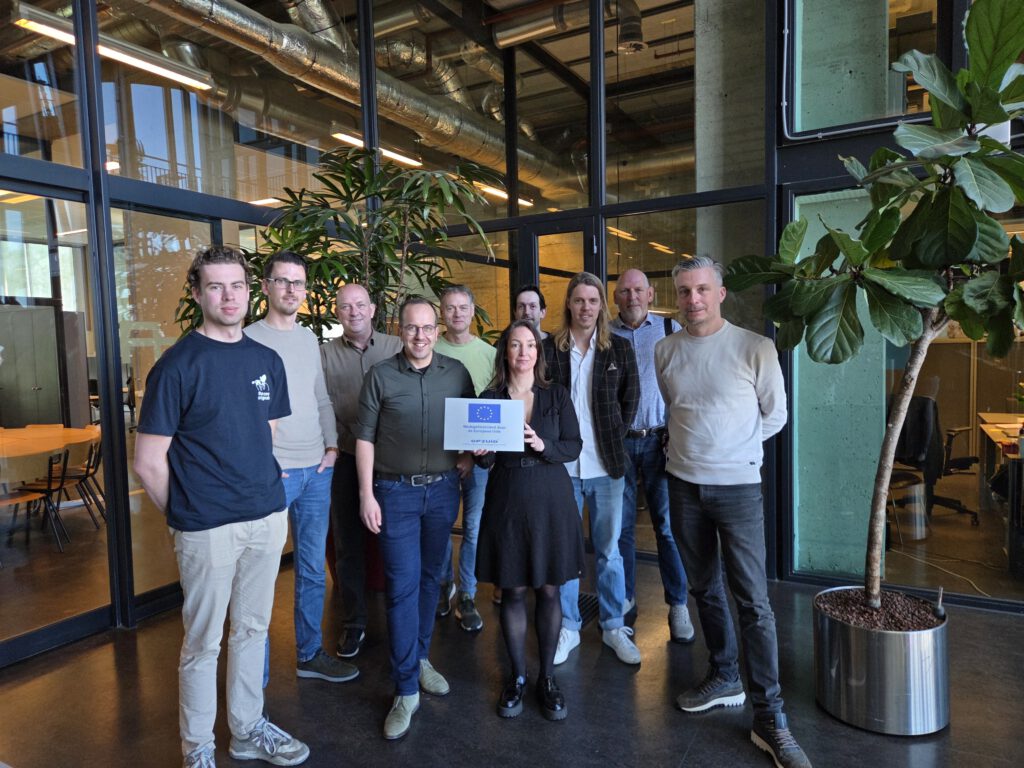
CoLiBRIE is a collaboration between RxDomi, ClimAd Technology, SolarTech International, FABBS Technologies, Newton Energy Solutions and Eindhoven University of Technology. Living Lab 040 also contributes through practical experimentation and knowledge development. The project runs until the end of 2027 and contributes to the innovation and sustainability ambitions of OPZuid and the broader energy transition in the South of the Netherlands.
This project is financially supported by the European Union through the European Regional Development Fund (ERDF) and by the Province of North Brabant.



What will be delivered?
The CoLiBRIE project will deliver the following results:
1) Lightweight, biobased housing concepts through grid-friendly “peak-load-free” homes having a maximum 4 kW grid connection designed for rapid and sustainable construction
2) Integration of smart energy technologies, including solar control window films, solar-thermal systems, thermal storage and intelligent battery systems
3) An advanced simulation and design tool for modelling such housing concepts
Do you want to know more? Check out the project page below.